
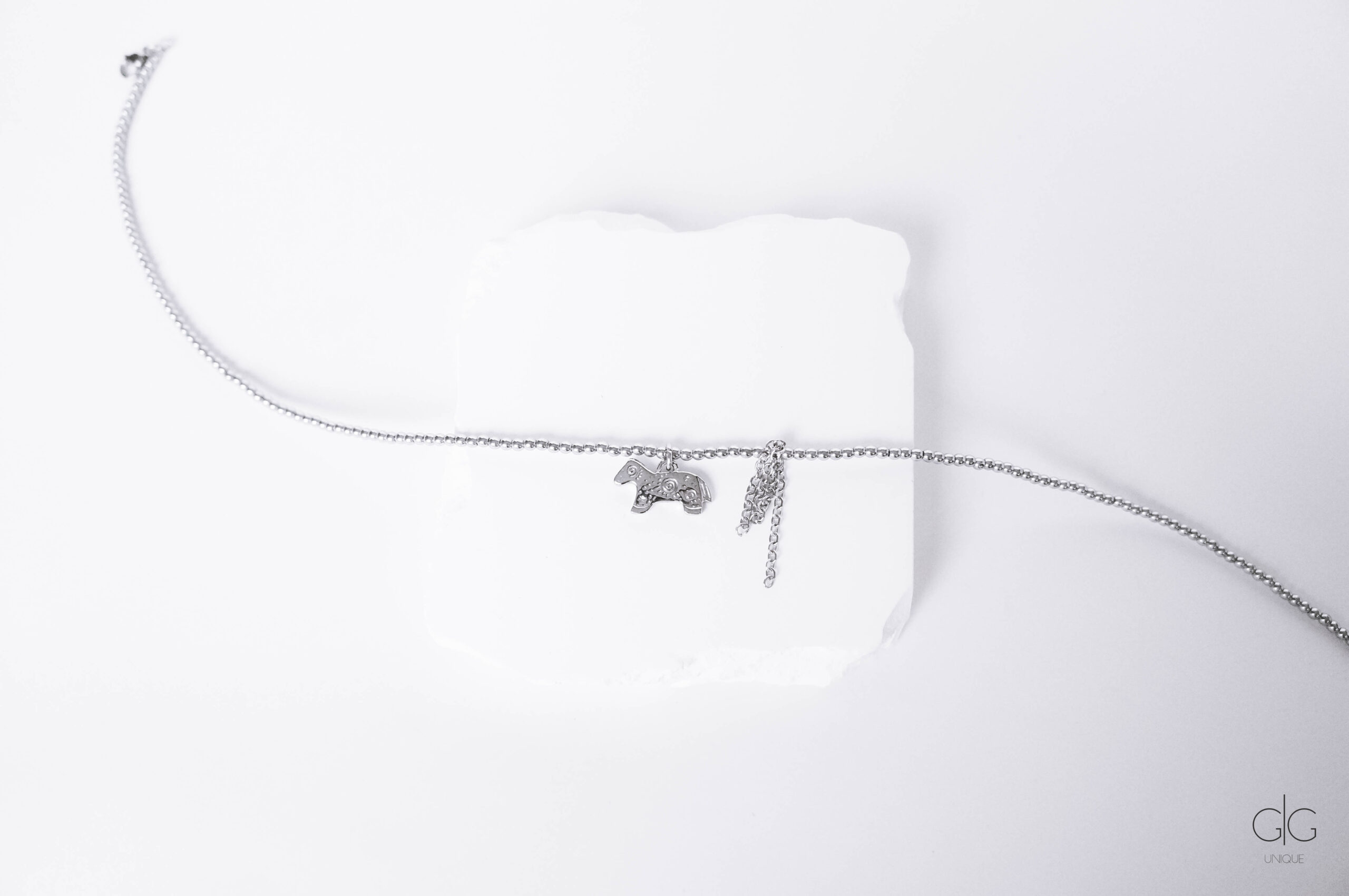
Hematite is one of those stones people wear for years before they ever learn its name. It is the dark, mirror-grey bead that gives a pearl necklace its weight, the cool metallic stripe in a lava stone bracelet, the little anchor on the end of a red string. If you have been searching for a hematite necklace and want to know what you are actually buying, this is the short, honest version.
What hematite actually is
Hematite is an iron oxide. That is the whole story, chemically speaking, and it explains almost everything about how the stone behaves. It is dense, so a hematite bead feels noticeably heavier than glass or plastic of the same size. It takes a mirror polish, which is why good hematite looks closer to gunmetal than to stone. And it is iron, so it is one of the few beads on a jewellery bench that a magnet reacts to.
The name comes from the Greek word for blood, which sounds dramatic until you grind a piece down. The powder is rust red. A polished black bead with a red streak underneath is the oldest way jewellers have told real hematite from an imitation.
Why hematite and pearls belong together
This pairing is not an accident of fashion. Pearls are soft, warm and slightly irregular. Hematite is hard, cool and perfectly reflective. Put a freshwater pearl next to a hematite bead and each one makes the other more visible: the pearl looks warmer, the hematite looks sharper.
There is a practical reason too. A strand of pearls alone can read as formal. Break it up with dark metallic beads and the same necklace becomes something you can wear with a shirt and jeans. That is the logic behind pieces like our exclusive hematite necklace with a Keshi pearl, where a single baroque pearl sits against a dark hematite line, and the hematite and freshwater pearl necklace, which alternates the two along the whole strand.
Grey, black or rainbow: which hematite are you looking at
Natural polished hematite
Steel grey with a slight brown undertone in daylight. This is the stone in its honest state, and it is what we use.
Black coated hematite
Deeper and flatter black, usually achieved with a surface treatment. It looks striking on day one, but the coating is the part that wears, not the stone.
Rainbow or aura hematite
The oil-slick purple and green finish is a thin metallic film applied over the bead. It is a legitimate decorative treatment, but it is a coating, and it should be described as one.
Magnetic hematite
Worth naming clearly, because it is widely sold as hematite and is not. Strongly magnetic beads are almost always a man-made ferrite compound. Natural hematite is only weakly attracted to a magnet. If a bracelet is sold on the strength of its magnetism, it is a manufactured material.
What hematite is said to mean
Across a lot of traditions hematite is the grounding stone. It gets associated with focus, steadiness and protection, which makes sense for a stone that is literally iron and literally heavy. Roman soldiers were said to rub it on themselves before battle. Modern crystal practice treats it as the stone you wear when your head is too busy.
We sell jewellery, not medicine, so here is where we stand: wear it because the meaning is one you like carrying, and because it looks good. Those are both good reasons. Neither of them is a health claim.
How to wear it
Hematite is a neutral, which is why it is easier to style than most coloured stones. It sits comfortably with silver and stainless steel, and it makes gold look warmer by contrast rather than fighting it. Against a white shirt it reads as a clean dark line. Against black it almost disappears, which is either the effect you want or the reason to choose something else.
Layering works well because the stone is visually quiet. A short hematite strand under a longer pearl necklace gives you depth without two necklaces competing. If you want the stone somewhere less obvious, the two-tone hematite bracelet and the unisex red string with a hematite stone put it on the wrist instead.
Caring for hematite
Hematite is hard but brittle. It resists scratches well and survives a sharp knock badly, so the realistic risk is chipping a bead on a door frame or a desk edge, not dulling it in a drawer.
- Wipe it with a dry or barely damp soft cloth. That is genuinely all the routine cleaning it needs.
- Keep it away from ultrasonic cleaners and steam. Both are too aggressive for a brittle stone strung on thread.
- Take it off before swimming. Chlorine and salt water attack the stringing and the clasp long before they touch the stone.
- Store it flat and apart from harder stones, so nothing knocks a polished face.
- Remember it is iron. Leave it soaking wet in a bathroom and you can get surface rust spots on lower grade material.
Buying without getting caught out
Three checks cover most of it. Weight: real hematite feels heavy for its size, and a bead that feels light is glass or resin. Colour underneath: a genuine piece leaves a reddish streak when rubbed on unglazed ceramic. Magnetism: strong magnetic pull means a synthetic compound, not natural stone.
Then look past the stone at the build. A hematite necklace is only as good as what holds it together, so check the clasp material, whether the strand is knotted, and whether the metal parts are stainless steel or a plated base that will change colour in a few months.
The short version
Hematite is polished iron ore: heavy, mirror-dark and hard-wearing. It carries a long association with grounding and protection, it costs a fraction of what people assume, and it is the most reliable partner a freshwater pearl has. If you want to see how the pairing looks in practice, the pieces above are the ones we make by hand in Lithuania.