Two amethysts can come out of the same rough stone, weigh the same, and cost very different money. What separates them is the cut. It decides how much light comes back out of the stone, how deep the colour looks, and whether the piece reads as quiet or loud on your neck.
Most guides to gemstone cuts are written for diamond buyers. Ours is written for people wearing natural stones, which follow slightly different rules. Here is what the cuts actually do, what the four cutting families mean, and how any of it helps you choose.
What a cut actually does
A cutter is solving one problem: get light into the stone, bounce it around, and send it back to the eye rather than out of the bottom. The flat faces that do this are called facets, and their angles matter more than their number. Cut too shallow and light escapes through the base, leaving a washed-out centre. Cut too deep and the stone goes dark.
Colour changes with cut too. A deeper cut gives light a longer path through the stone, which saturates the colour. That is why a pale aquamarine is often cut deep and a dark amethyst is cut shallower. The cutter is balancing sparkle against colour, and with coloured stones colour usually wins.
The five cuts you will meet most often
Round brilliant
Fifty-seven or fifty-eight facets arranged to maximise light return. It is the most efficient sparkle geometry anyone has found, and it wastes the most rough material getting there. Round brilliant reads as classic and slightly formal.
Oval
Brilliant faceting stretched along one axis. It keeps most of the sparkle, covers more surface for the same weight, and lengthens the look of a finger or a neckline. Ovals suit people who want presence without a round stone’s formality.
Emerald, or step cut
Long parallel facets in rows, like steps, with the corners cut off. Instead of scattering light, it produces broad flashes and a window straight into the stone. That honesty is the point, and it is also the risk: a step cut hides nothing, so it wants clean material.
Cushion
A square or rectangle with rounded corners and larger facets than a modern brilliant. The result is a softer, warmer glow rather than sharp scintillation. Cushion cuts came out of the 1800s and still carry that antique feeling.
Pear
Half brilliant, half marquise, with a point at one end. It moves the eye and works beautifully as a pendant, where the point hangs naturally downward. It is also the cut most sensitive to symmetry, and a badly cut pear looks lopsided immediately.
The four cutting styles behind those shapes
Shape and style are different things. A pear is a shape. The way its facets are arranged is a style, and gemmologists group those into four families. The International Gem Society lays this out well, and their figures are worth borrowing.
Brilliant cuts
Triangular and kite-shaped facets engineered for light return. The round brilliant alone accounts for roughly 75% of diamond sales, which tells you how thoroughly this style has trained everyone’s eye.
Step cuts
Rectangular facets in parallel rows. Made for clarity and colour rather than fireworks. Emerald and baguette cuts live here.
Mixed cuts
Brilliant faceting on top, step faceting below, or some other combination. Common in coloured stones because it lets a cutter chase sparkle and colour saturation at the same time.
Fantasy cuts
Carved grooves, concave facets, asymmetry. These are cut by artists rather than to a formula, and no two are alike. They cost more per carat and they are the reason a single stone can look like a sculpture.
Cutting is also regional. India has been cutting stones for something close to 4,000 years, and Thailand built a modern industry on top of a long craft tradition. Where a stone was cut often tells you as much about how it looks as which machine cut it.
Cabochons: the cut most natural stone jewellery actually uses
Here is the part diamond guides leave out. Faceting suits transparent material. A lot of the stones we love are translucent or opaque, and faceting them would look flat and lifeless. Those stones get cut as cabochons instead: a smooth domed top, a flat back, no facets at all.
A cabochon is not a lesser cut. It is the correct one for stones whose beauty lives in pattern, banding, or the way light moves under the surface. Moonstone’s blue shimmer, labradorite’s flash, the bands in an agate and the soft body of pink opal only appear when the surface is curved and polished rather than broken into facets.
The practical consequence: when you shop natural stone jewellery, the question to ask about the cut is whether the dome is even, the polish is free of pitting, and the stone sits low enough to survive daily wear. Height matters more than facet count. A tall cabochon on a ring catches on everything.
How our Inner You pieces use cut and stone
Every stone in the Inner You collection is chosen and set by hand, and the cut follows the material rather than the other way round.
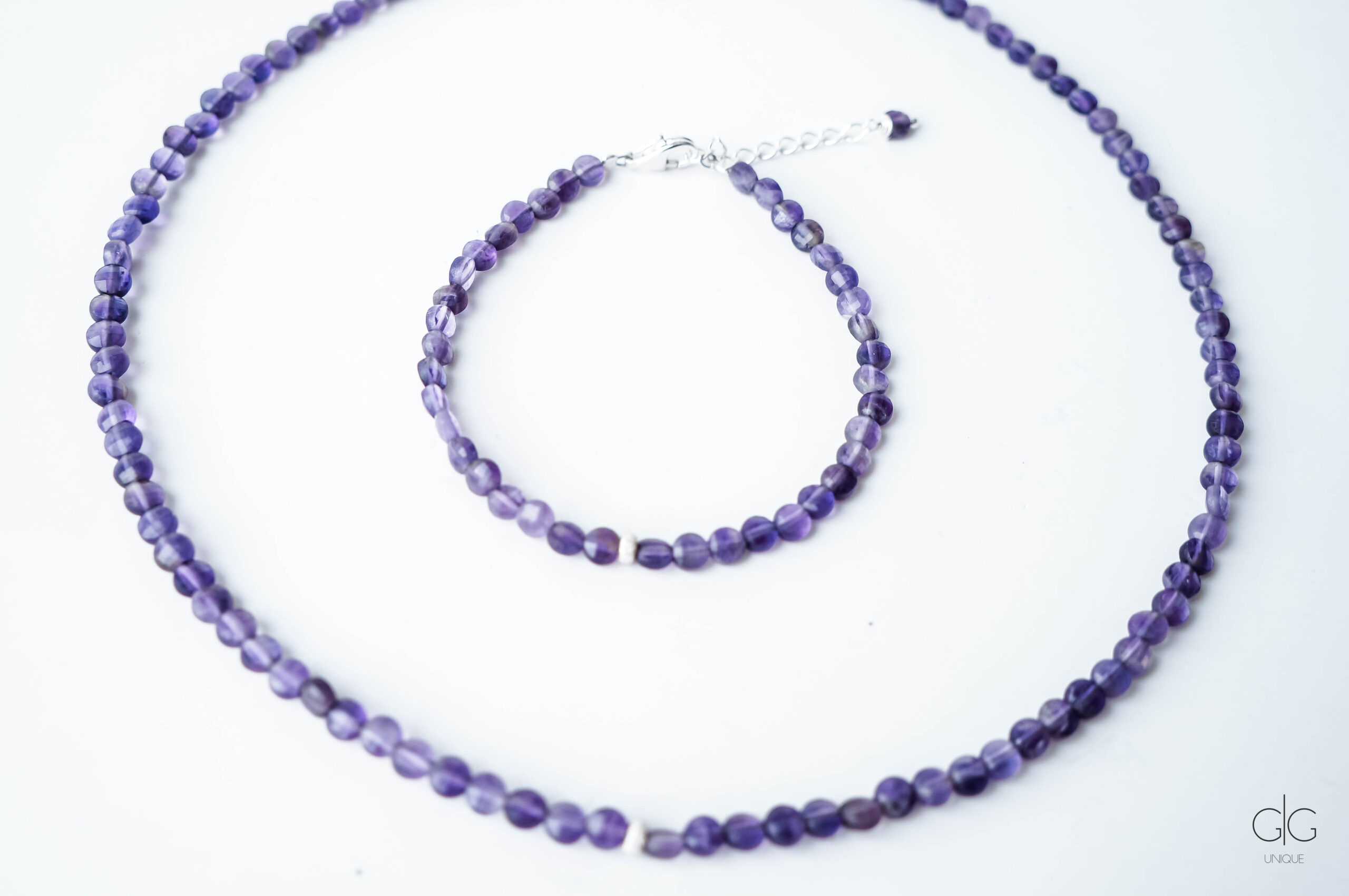
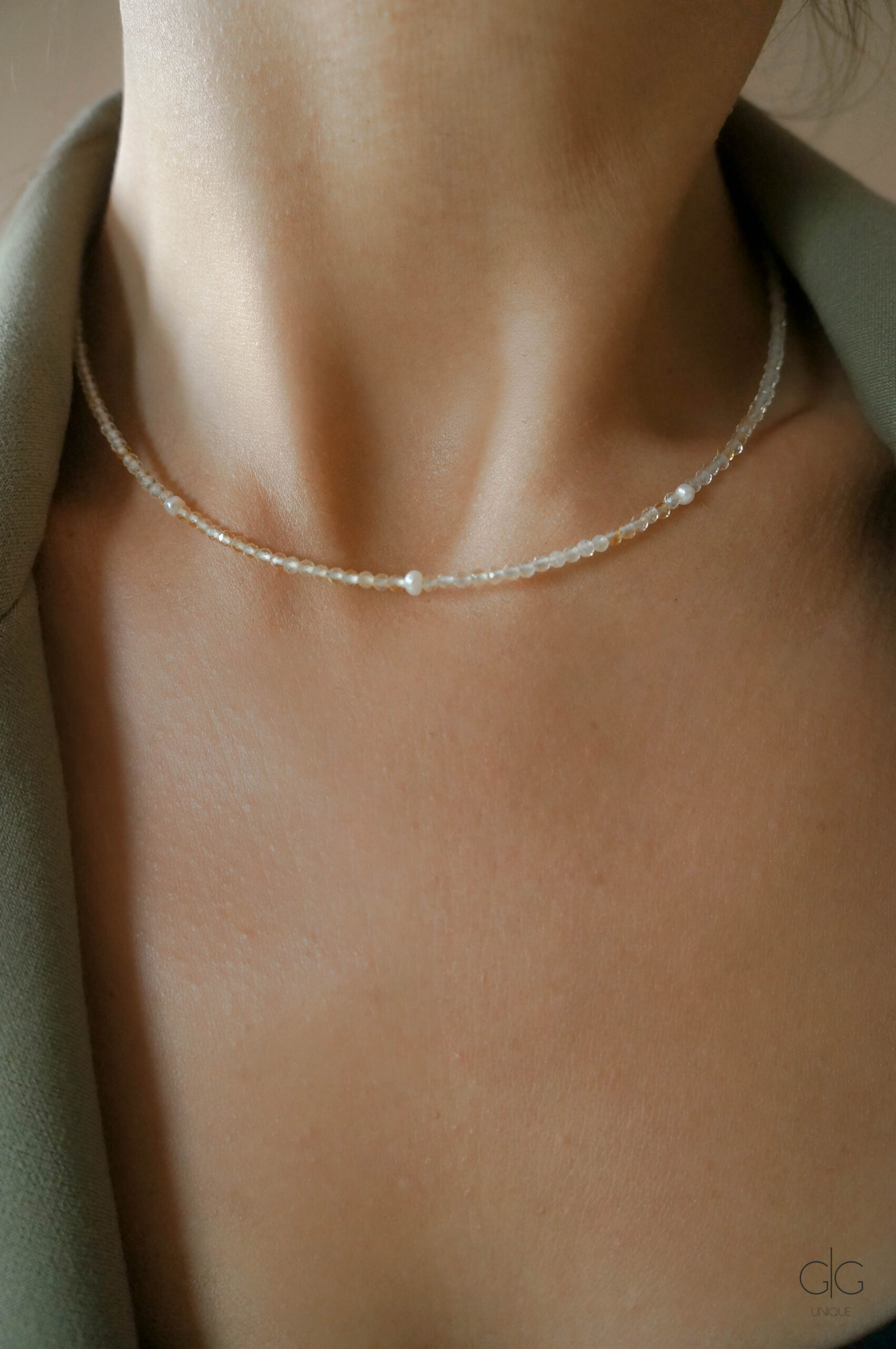
Transparent stones get faceted so light comes back through them. The amethyst necklace with 925 silver and the citrine necklace with freshwater pearls both use faceted stones, cut on the shallower side so the colour stays bright rather than going inky.
Patterned and softer stones get cabochons. The agate necklace shows its banding because there are no facets breaking the surface, and the labradorite necklace needs a curved top for its flash to appear at all. The pink opal is the same story in a quieter register.
Pale stones get depth. Aquamarine is naturally light, so a deeper cut gives the light a longer path and the colour more to say.
Choosing a cut that suits you
Strip away the romance and this is a practical decision with three inputs.
How much attention do you want? Brilliant and mixed cuts throw light and get noticed across a room. Step cuts and cabochons are quieter and read as considered rather than sparkly.
Where will you wear it? Rings take knocks, so low profiles and rounded edges last longer. Pendants and earrings can afford points, tall domes and delicate corners because nothing rubs against them.
What is the stone itself doing? If the material has pattern or an optical effect, a cabochon shows it. If it is clear and coloured, faceting brings it alive. Fighting the stone rarely ends well.
About the symbolism
Cut symbolism is worth being straight about. Round meaning unity, pear meaning renewal, step cuts meaning clarity: these are cultural associations that built up over centuries, and they carry real weight for the person wearing the piece. They are not properties of the mineral.
We mention them because they help people choose, and choosing a piece that means something to you is most of why anyone buys jewellery rather than just wearing none. Take the associations as a language, and let the stone and the cut be the physics.
The short version
Cut controls light, and light controls how a stone looks. Faceted cuts belong on transparent material, cabochons belong on everything with pattern or an optical effect, and the best cut for you is the one that suits both the stone and the way you actually live.
If you want to see the difference in person, the Inner You natural stone collection has both kinds side by side, and every piece is made by hand here in Lithuania.
With love,
GG UNIQUE